


Missing a Mahjong Tile? How to Identify, Replace and Match It
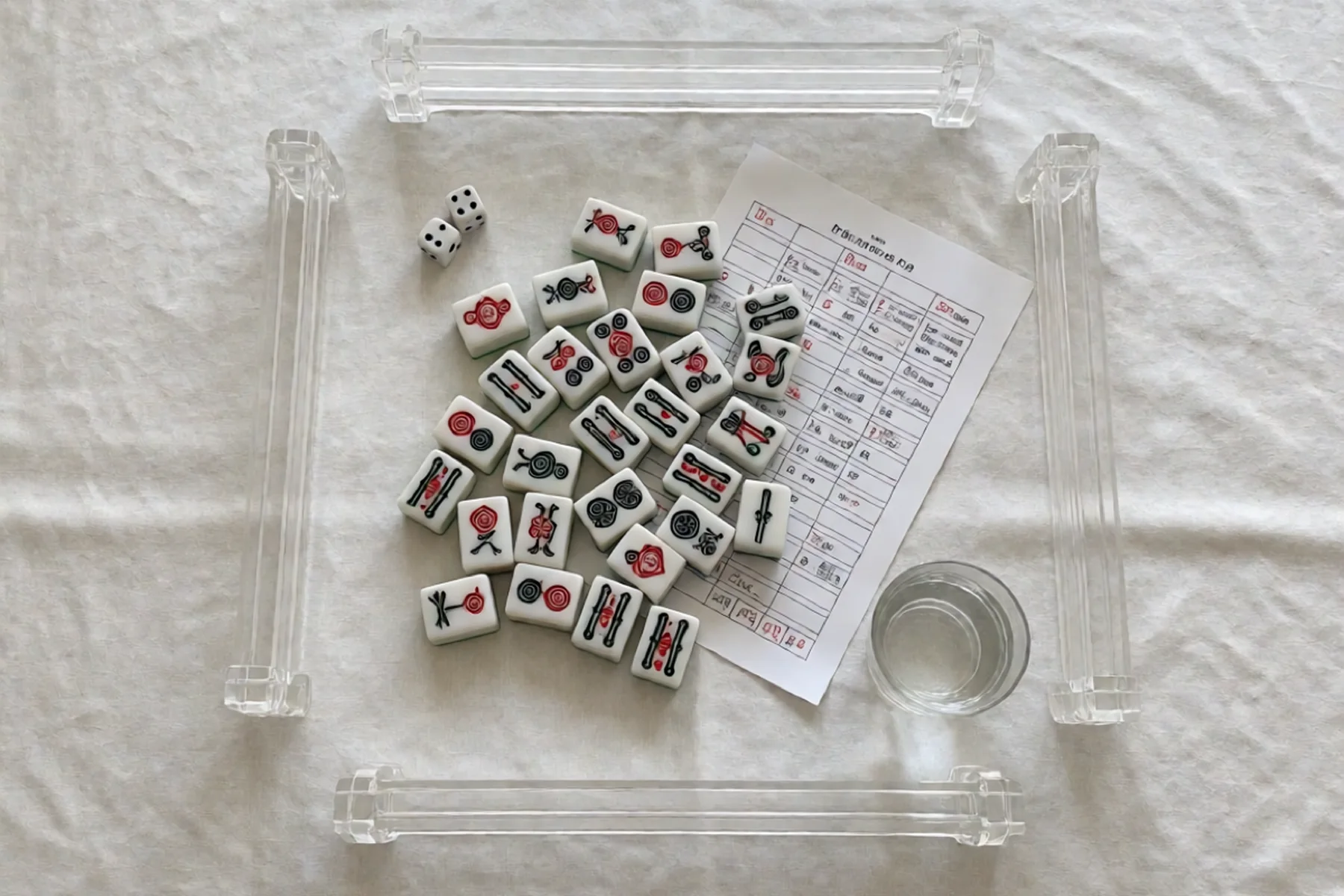
A missing American mahjong tile rarely disappears in a dramatic way. It is usually found after a set has been packed away for months, discovered by one player while the other three are already seated, or noticed only when a hand needs exactly the tile that is not there. The practical question is not who lost it. It is whether the tile can be identified, replaced and matched closely enough that the set remains playable.
The answer depends on the tile size, material, back colour, edge construction, face artwork and the age of the set. A replacement does not have to be invisible from every angle, but it should sit at the same height in the rack, resist the same kind of wear and be distinguishable from the other suits without creating confusion during play.
First, confirm that the tile is actually missing
Before ordering a replacement, empty the entire case and count by group. Check the lid, the spaces between racks, the bottom of the bag and the gap behind the case lining. Small tiles can slide under a pusher or remain in a tile bag when the rest of the set has been returned.
Count once by suit, once by honour tiles and once by jokers or blanks. Use the set's original packing list or the manufacturer's count if one exists. The standard American game is often described as a 160-tile set, but packaging and special editions vary. How Many Tiles in an American Mahjong Set? explains the 160-tile count and why the number matters before you assume a piece is lost.
Separate a missing tile from a matching problem
A tile can be present and still feel missing. One joker may sit in a different compartment, or a flower tile may have been placed with the wrong group during the previous game. Put the set on a clean mat and lay it out in the normal rack order rather than sorting quickly by colour alone.
If you play with more than one set, compare the storage cases before ordering. Two sets with similar backs can become mixed after a shared game night. A tile that does not match the rest may belong to another set rather than being a manufacturing defect. For a wider view of what belongs in the case, see What Comes in an American Mahjong Set.
Identify the tile before you search for a replacement
Record the suit or function
Write down whether the missing piece is from dots, bams, craks, winds, dragons, flowers, jokers or blanks. Do not rely on memory after the table has been cleared. A photograph of the remaining tile group is more useful than a general description such as “a green tile.”
If the missing tile is one of a pair or group, place the remaining pieces together and photograph the faces. For a wind or dragon, note the exact lettering style and colour. For a flower, look at the illustration, number and any small edition mark.
Measure the tile
Measure width, height and thickness in millimetres. Do not measure only one face. Use a ruler against the side edge and write down the thickness because a replacement can look correct from above and sit too high in the rack.
A digital caliper is more reliable than a phone ruler if one is available. Measure three tiles from the same set and use the most common result. Tile sizes and official standards are explained in Mahjong Tile Sizes.
Photograph the back and edge
Turn several matching tiles upside down and photograph them in daylight. The back colour may be warmer or cooler than it appears at night. Note whether the tile is one-layer, two-layer, three-layer or a multi-layer acrylic construction. A side-on photograph shows the edge colours and alignment.
Gloss level also matters. A glossy tile beside a matte replacement catches light differently and can become a visual distraction. American Mahjong Tile Backs explains how colour, glare and matching work together.
What information a seller needs
A useful replacement request includes the set brand or product name if known, the tile size in millimetres, the material, the back colour, the number of layers, the missing face and clear photographs of both the front and the side. If the set is out of production, the photographs become more important than the brand name.
Do not ask only for “one green dragon.” There may be several green dragons with different fonts and finishes. Send the remaining tile as a reference when possible, or place a ruler beside it in the photograph so the seller can compare scale.

Can a different tile be used temporarily?
A blank tile, a spare from another set or a clearly marked placeholder can keep a game moving if everyone agrees. Put the substitute in the same rack position and announce what it represents before the first hand. Never quietly swap in a tile with a different back and assume the other players will remember.
A temporary tile should not change the legal condition of the set for a tournament or club game. For a casual home game, the priority is that all four players can identify the piece and that it behaves like the tile it replaces.
Matching acrylic and melamine tiles
Acrylic and melamine sets are not interchangeable just because both feel smooth. The materials have different weights, edge reflections and sound. A replacement should match the thickness and approximate weight, not only the colour printed on the back.
If the original tiles are layered, the replacement needs the same layer construction or the rack will sit unevenly. Melamine vs Acrylic Mahjong Tiles compares weight, feel and care. For a printed or engraved face, Engraved Melamine vs UV-Printed Acrylic explains why the finish affects durability and price.
Do not sand or polish a replacement at home to make it fit. A changed edge can remove the protective layer, create a sharp corner or make the tile sit differently. If the replacement is too thick or too tall, return it and ask for the correct specification.
What to do when the exact tile cannot be found
Some small-batch or seasonal sets cannot supply a single exact match. In that case, choose the closest structurally compatible tile and use it with a consistent visual mark. A small dot on the back, agreed by all players, is less confusing than a tile that almost matches and is mistaken for an original during play.
If the set is primarily decorative, a missing tile may still be acceptable for display. If the set is meant to be played, a complete playable group matters more than an untouched photograph. Decide which role the set serves before spending a large amount on one replacement.
Prevent the next missing tile
Count at the end of the evening, not only at the beginning. Put the jokers and blanks in their designated compartments before the racks are moved. Keep the case closed when the table is being cleared and check the floor beneath the table before guests leave.
A small labelled pouch for spare tiles, a card and the storage instructions makes future maintenance easier. Mahjong Tile Storage covers bags, cases and organizers. The American Mahjong Tiles collection is the place to compare new sets when a single replacement no longer makes sense.
When to replace the set instead
Replace the whole set when several tiles are missing, when the remaining tiles are chipped or unstable, or when the back colours have faded unevenly. A set with one missing tile can be repaired; a set with several incompatible substitutes becomes a different playing experience.
If you are buying a new set, check the size, material and back consistency before the artwork. A beautiful design does not help if replacement tiles cannot be matched or if the racks feel crowded. American Mahjong Tiles and American Mahjong Mats are two different starting points: the first solves the tile problem, the second protects the table and improves the feel of play.
A practical replacement checklist
Count the set. List the missing face. Measure the tile. Photograph the back and edge. Note the layer construction. Compare the replacement weight. Test the thickness in the rack. Mark any temporary substitute clearly. Keep the replacement information with the set for the next owner.
A missing tile is annoying, but it is rarely the end of a good set. With careful identification, a replacement can keep the game coherent without pretending that the history of the set never happened.
Frequently asked questions
Can I replace just one mahjong tile?
Often yes, if the size, material, back colour and layer construction can be matched. A single replacement is most successful when the original set is still in production or when the seller has detailed specifications.
Do mahjong tile backs need to match exactly?
They do not need to be invisible, but they should be close enough that the replacement does not become an unintended signal. Matching colour, gloss and thickness protects fair play and keeps the rack level.
Can I use a blank tile as a temporary replacement?
Yes for a casual game if all players agree and know what it represents. A blank tile is not a permanent substitute for a tournament set unless the rules and organizer allow it.
What size should I measure?
Measure width, height and thickness in millimetres. Measure several tiles from the same set and use the most consistent result rather than a single rounded measurement.
Keep the set playable
The goal of replacement is not to erase the fact that a tile was lost. It is to preserve a set that already has a place at the table. Once the replacement fits the rack, feels right in the hand and can be identified by every player, the set is complete enough to keep playing.