


Understanding American Mahjong Scoring: Points, Racks, and Hand Values
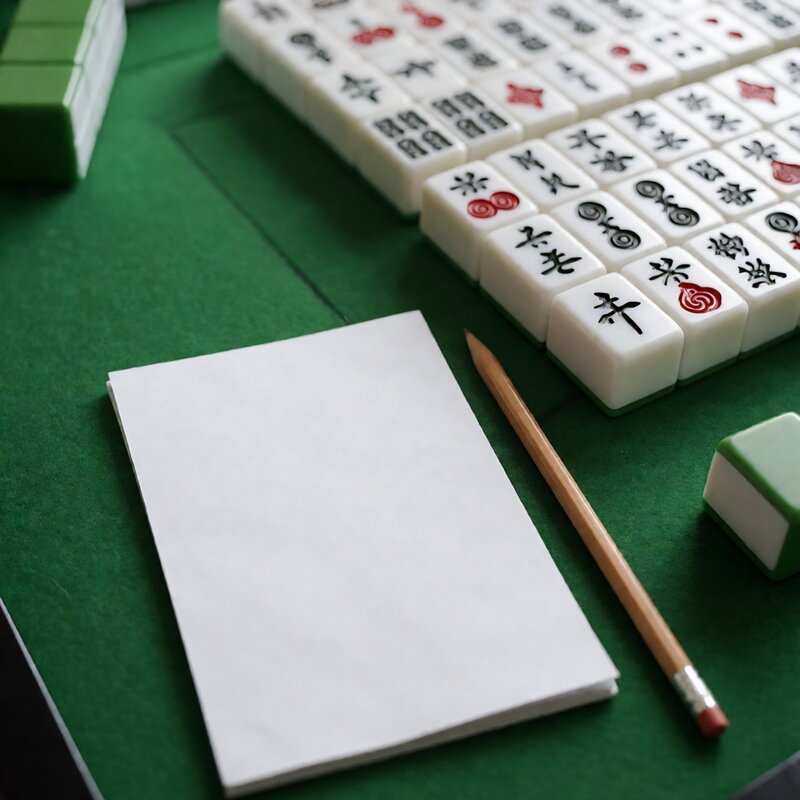
American mahjong scoring looks complicated for about one session and then becomes second nature. Unlike variants where a single dominant hand can decide a round, the American game keeps scores close across the match, which is why every hand is worth playing out carefully.
Points come from the card, not from a formula
Each winning hand on the annual card carries a printed point value. You do not calculate it from suits or combinations; you read it. That is the first thing to internalise, because it changes how you plan: a hand is worth chasing only if its value and its difficulty make sense for the current score.
Points generally scale with difficulty. Simple hands with many jokers sit at the low end; hands that require specific tiles, exact suits or no jokers at all sit at the top. The card also states how many jokers each hand allows, which is often the real limit on how fast it can be built.

Exposed and concealed hands
Building in the open is normal, but it has a cost. A concealed hand, finished without exposing any melds, is worth more. Exposing a meld makes the hand easier to complete and easier for opponents to read, and the card usually pays for that difference.
How payment works
In the standard American structure, all players pay the winner, with the amount depending on whether the hand was concealed, whether the final tile was discarded by an opponent, or whether the winner drew it themselves. Doubling conventions vary between tables, so the first round of a new group is the right time to confirm them.
The practical effect is that a win off someone else's discard is usually the cheapest outcome for the table, and a self-drawn concealed hand is the most expensive. That difference is what makes players cautious about throwing a tile that looks like it completes something.
Reading the score, not just the hand
Good players track two things at once: what the card pays for a hand, and what the table can afford. Late in a match, a low-value hand that finishes quickly can be better than a high-value hand that never arrives, because a joker-heavy simple hand still collects from three players.
It also pays to note which hands opponents have exposed. If two people are both visibly building toward the same suit, the tiles you need are more contested, and switching early is cheaper than switching late.
Common beginner mistakes
- Chasing a printed high-value hand that needs tiles already visible on the table.
- Exposing a meld for speed, then discovering the card requires that hand to stay concealed.
- Forgetting the joker allowance, and building a hand that turns out to be illegal.
- Throwing a tile on the last few turns without checking what the exposures suggest.
Scoring rewards attention more than arithmetic. Once you can read the card quickly and remember what is already face-up, the numbers take care of themselves.
Points come from the hand, not a universal chart
American mahjong scoring is tied to the hand patterns printed in the current card or to the card declared by the group. A value should come from the applicable reference, not from a generic score remembered from a different edition. This is why players keep the card visible and check the exact hand before declaring the result.
When comparing hands, read the card carefully: suit restrictions, number combinations, pair requirements and joker instructions all matter. A hand that looks visually complete can still fail if one element does not match the printed pattern.
Why rack tracking helps
Some groups use scorekeeping and rack tracking to follow the progress of a game or session. Whatever method the group uses, the record should be agreed before play begins. Write down the card edition and any house rules beside the score so a later review does not depend on memory.
Keep the reference with the set
Store the card in a sleeve or pocket that keeps it flat and separate from loose tiles. If you are buying a set for a gift, do not assume a card is included. Confirm the package contents and ask which edition the recipient's group uses. Read Understanding the NMJL Chart and What Comes in an American Mahjong Set before ordering.
Score with the card in view
Before recording a value, read the hand name, suit conditions and joker rules directly from the edition in use. If the group has a house rule, write it beside the score. A shared written reference prevents a friendly game from turning into an argument about memory.
Write down the edition
Record the card edition or ruleset beside the score sheet. A value without its source is difficult to review later and easy to confuse with a hand from another year.